






























Fantasy Football Week 3 Usage Report: Jordan Mason, Jameson Williams and More
Ted examines fantasy football players who are seeing exciting or disappointing usage trends after Week 3.
All experienced fantasy football managers know that usage is king. Aside from a few outliers, most players produce fantasy points relative to the number and type of touches they see.
This means targets, carries, routes, and, since you have to be on the field to touch the ball, snaps are all very important stats to consider when predicting a player's fantasy outlook.
We should also consider where these opportunities come — a target in the end zone is worth a lot more than a target at midfield. FantasySP puts all this info in one place with the Target/Touch/Red Zone Leaders page. Today, we're using these numbers to identify players seeing elite usage, and those whose usage isn't quite as impressive as you might expect given their name value and/or raw fantasy production. Let's get started
Check out the top waiver wire options at each position every week. Explore the best in-season fantasy football tool to manage your team and get league rankings with the Fantasy Assistant. Use our trade analyzer and trade value charts to break down trade scenarios with Fair Trade ratings.
Positive Usage Players
WR Chris Olave, New Orleans Saints
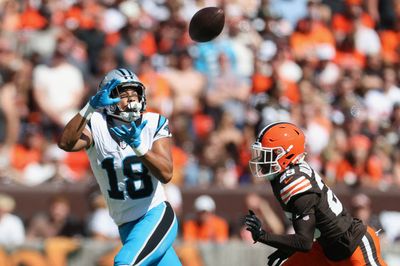
No player has seen more targets so far this season than Olave, with 37. He has seen double-digit targets in every single game. Of course, he is “only” the half-PPR WR32 with 9.3 points per game. His 62% catch rate isn't great, and he has yet to score a touchdown.
You might be tempted to say that this level of underperformance compared to volume will continue for Olave. After all, a target from Spencer Rattler is probably worth less than the average NFL target.
While that is true, Olave is still definitely headed for positive regression if this volume continues. He'll hit pay dirt eventually (he has four red zone targets, so it's not like he's a non-factor near the end zone), and he's also certainly capable of breaking a big play. He's a sneaky buy-low candidate if his current manager is disappointed with his low ceiling so far this season.
Connect your league to uncover strengths & weaknesses, waiver assistance, trade scenarios, and get instant start/sit clarity.
TE Jake Ferguson, Dallas Cowboys
Here are the players with more targets than Ferguson so far this season: the aforementioned Olave, Puka Nacua, and Malik Nabers. That's it. Dak Prescott has always made a habit of feeding his tight ends, but this is a whole new level of volume.
Dak is tied for the lead in passing attempts, which does help Ferguson's raw numbers. His 24% target share is elite for a tight end, but not as absurd as his 10.7 targets per game.
However, there's no reason to predict massive regression for Dallas' passing volume. Their defense is terrible, their run game is lucky to be mediocre, and they play fast. With CeeDee Lamb out for the foreseeable future, Ferguson should be able to maintain a solid share of targets. He is a locked-in TE1 going forward.
RB Jordan Mason, Minnesota Vikings
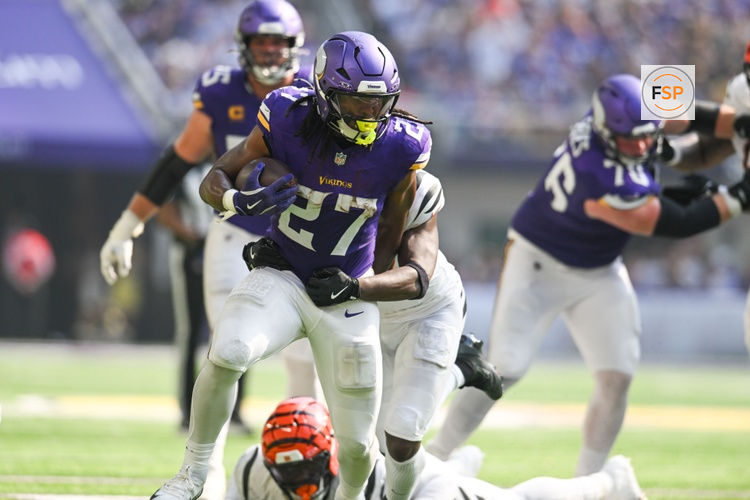
Week 3 was our first look at the Vikings' backfield without Aaron Jones Sr., who is on the IR with a hamstring injury. Mason served as a bell cow, handling 16 carries (55% RB rush share) on a 60% snap share. Pass-catching has always been a weakness in his profile, and he didn't see a target, but he did lead the Vikings' backfield with a 45% route participation rate.
However, these numbers really aren't that great for a guy whose biggest competition was Zavier Scott and fresh-off-the-couch Cam Akers. However, the Vikings absolutely dominated the Bengals in this one, which led to them resting Mason down the stretch.
If we filter to the first three quarters, his numbers look borderline elite: 76% RB rush share, 76% snap share, 52% route participation rate. And that's still including plenty of garbage time, as this game was essentially over by halftime. In more competitive game scripts, Mason's usage could be even better — he's a borderline RB1 as long as Jones is out, especially if he can start catching just a couple of passes.
RB Woody Marks, Houston Texans
I've talked about this a couple of times already on this site, so I'll keep this one short. But Marks' role just keeps improving every week. He has steadily climbed up the Texans' depth chart, rising from fourth on the team with an 11% snap share in Week 1 to just behind Nick Chubb with a 48% snap share in Week 3.
Now, Marks wasn't a very exciting prospect, and he hasn't been particularly impressive so far this season. The Texans' offense isn't exactly firing on all cylinders either. But we simply can't ignore it when a rookie RB, especially one with pass-catching chops, is seeing their role grow this fast. Marks should have been added in every league this morning; make sure he was in yours.
Negative Usage Players
WR Ladd McConkey, Los Angeles Chargers
It's officially time to be worried about McConkey. He was drafted as a borderline WR1, with the expectation that he would be the clear top target for Justin Hebert. Three weeks into the season, he ranks third on the Chargers in targets with just a 19% target share.
This isn't necessarily McConkey's fault. He's simply dealing with far tougher competition for targets than we expected. Keenan Allen has always been a target hog and isn't yet showing his 33 years of age, and Quentin Johnston has leveled up his game.
Things aren't all bad. McConkey is still a talented player and leads the Chargers in routes run. LA's offense has also been both condensed and pass-happy, which makes it more likely that these three WRs can coexist. The sophomore WR will certainly have his chance to shine at some point … but he's not going to be the target hog you drafted him to be.
RB Jacory Croskey-Merritt, Washington Commanders
With Austin Ekeler out, the hope was that Croskey-Merritt, aka “Bill,” would step up as the Commanders' clear lead back in Week 3. And the seventh-round rookie did lead the backfield in snaps, so that's something. But he carried the ball just eight times, three fewer than Chris Rodriguez Jr., and only one more than Jeremy McNichols.
In the passing game, Croskey-Merritt led this trio in both route participation and target share. But neither a 22% route participation rate nor a 5% target share (aka one target) is anything to get excited about.
Hopefully, JCM's role expands as the season moves on. After all, Rodriguez was a healthy scratch for the first two weeks of the year, and McNichols is a career special-teamer. If there's going to be any juice in this backfield, it's got to come from the rookie.
But there's a chance this backfield is simply juiceless, especially if it remains an ugly three-way committee. Don't give up hope if Croskey-Merritt is on your roster, but I wouldn't recommend rushing to acquire him, either.
WR Jameson Williams, Detroit Lions
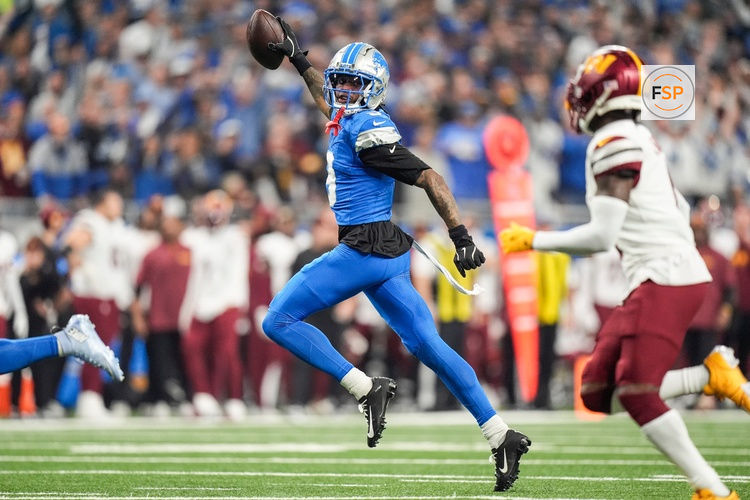
Williams is the kind of player who doesn't need elite volume to be a usable fantasy asset. He can have a big day with just one touch, and he was able to finish just inside the top-20 receivers last season despite an uninspiring 17.6% target share.
But part of the hope for Williams coming into this season was that he would be able to combine his explosive ability with a larger role in Detroit's offense. So far, that simply hasn't happened. His target share has fallen even further, to just 12.6% (four targets per game).
Unsurprisingly, this has resulted in Williams having mixed results for fantasy: he had a 44-yard TD and a big game in Week 2, but finished below six half-PPR points in his two other outings. Going forward, expect Williams to continue as a boom-or-bust flex option unless his usage grows substantially — even if he gets back to last year's numbers, he will still be a volatile asset unless the Lions' offense returns to historic efficiency levels.