

























Fantasy Football Draft Strategy: What is Handcuffing and Should You Do it?
Wondering whether you should "handcuff" in your next fantasy football draft? Ted Chmyz breaks down this classic strategy, including when and how to best use it to your advantage.
If you've spent much time in the online fantasy football world, you've probably heard the term “handcuff.” This simple strategy has become ubiquitous in fantasy discourse, to the extent that its original meaning isn't always clear.
In this article, I'll break down what exactly handcuffing is, as well as when and how to best employ this strategy. Let's get right into it!
For the latest player updates, be sure to head to FantasySP to utilize the real-time player news engine for all sports. The player news engine is the most robust and fastest player news system in fantasy sports. Signing up for a FantasySP membership can help you track all your fantasy players.
What is Handcuffing?
First things first: What even is a “handcuff”? The term comes from a bygone age of fantasy football, when most NFL teams had a single workhorse running back. Thanks to the consistent volume they received, those players absolutely dominated the fantasy football landscape. Of course, with high volume comes high injury risk, and losing your stud RB1 was (and still is) a brutal hit to any fantasy team.
With this in mind, some fantasy managers began employing a new strategy to mitigate that risk. After snagging a stud RB early in their draft, managers would ensure that they also drafted that stud's backup. That way, they would still have the team's starting back (and access to all that juicy volume) in the event of an injury or other unforeseen circumstance. Because they were so closely tied to their star teammates, these backup RBs with injury-contingent upside became known as “handcuffs,” and the practice of drafting them became “handcuffing.”
Connect your league to uncover strengths & weaknesses, waiver assistance, trade scenarios, and get instant start/sit clarity.
Although the NFL and fantasy football landscapes have shifted greatly since the term's inception, handcuffing remains a prominent fantasy football strategy today. Many veteran fantasy football managers will insist on drafting the backups to their star running backs, especially if that early-round star has particular injury concerns. In most cases, when you see a player referred to as a handcuff or a move referred to as handcuffing, this simplest scenario is what is being referenced.
Can You Handcuff a WR, TE, or QB?
In case you hadn't noticed, my default definition of handcuffing only involved running backs. This makes sense, as running backs are the most frequently injured and volume-dependent fantasy position. But is it possible to handcuff other positions? Technically, the answer to this question is yes.
There's nothing stopping you from drafting a backup wide receiver, tight end, or quarterback on the same team as one of your early-round starters at the same position. However, handcuffing at other positions is almost always an inoptimal use of resources.
The main reason for this is simple. At running back, fantasy scoring is determined largely by volume, which in turn is determined by coaching decisions. Most NFL teams will give the majority of their backfield work to one back, who in turn will likely be a fantasy-viable player, regardless of his individual skill level. The same isn't true for other positions.
For wide receivers and tight ends, volume (aka targets) is earned. If you don't get open, you won't see the ball. If Justin Jefferson misses time, Jalen Nailor is not going to see anywhere near the same amount of targets, even if he technically takes over the same role in the Vikings' offense.
A team's secondary receivers will sometimes (but not always) see increased volume and fantasy scoring when their top target is sidelined. But this increase is rarely enough to turn previously irrelevant players into must-starts, which happens consistently for running backs.
Quarterback is slightly different. Like running backs, backup QBs often pick up 100% of the volume when a starter is sidelined. The difference here is that there simply aren't as many quarterbacks ready to turn volume into fantasy-relevant production as there are running backs. Running back talent is so deep across the NFL that plenty of teams have second, third, or even fourth-string options who are capable of being useful fantasy players with a starter's workload. But there aren't even 32 quarterbacks who can play well enough in the NFL to be viable fantasy options, let alone 64.
With the exception of a few “bad for real life, good for fantasy” types — think Jameis Winston or Ryan Fitzpatrick — most backup quarterbacks will be so putrid that they fail to make any fantasy impact when given an opportunity. Even considering those rare productive backups, QB injuries are much less common, meaning a backup quarterback is far more likely to burn a hole in your bench for 17 weeks than a backup running back.
There are infrequent exceptions where handcuffing a position other than running back is a useful strategy. These usually come in leagues with particularly deep rosters, where spending a bench slot is less costly and the waiver wire is bare of replacement-level production. I particularly recommend considering handcuffing in deep dynasty formats when you have a very competitive roster.
In this case, replacing Mark Andrews with Isaiah Likely or Joe Burrow with Jake Browning may be just what your team needs to stay relevant late in the season. In traditional redraft leagues, don't bother handcuffing non-RB positions.
Should You Handcuff RBs?
Now that we've narrowed down our list of potential handcuffs to one position, it's time to answer the most important question: Is handcuffing a good draft strategy?
To answer this question, we need to focus on the goal of playing fantasy football. For me, the goal of any fantasy season should always be to win the championship. If you ain't first, you're last. As long as you agree with this ethos, you will soon see that handcuffing, in its most traditional form, is a mistake.
After all, the classic version of handcuffing is, at its core, a risk-minimization strategy. By stashing the backup to your first-round RB, you reduce the chances that your roster falls apart completely. That's not nothing, especially with the high-variance nature of most fantasy football playoff formats. Sometimes, staying alive is key.
However, in most fantasy football leagues, the eventual trophy-winner is one of a few teams with a stacked lineup. And handcuffing actually reduces the chances you end up with a stacked lineup.
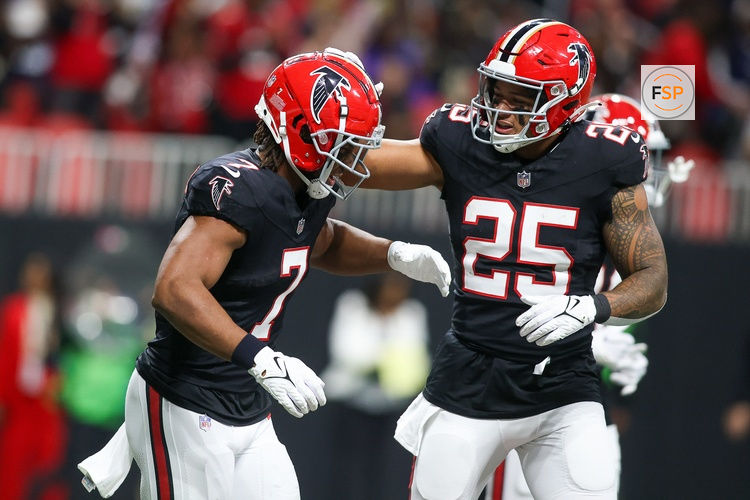
This becomes clearer with an example: One of the best traditional handcuffs in the league right now is Tyler Allgeier. If you draft Bijan Robinson as your RB1 in Round 1, you can feel comfortable that adding Allgeier later in the draft gives you a stranglehold on the Falcons' backfield. But Allgeier is only a helpful fantasy player if Robinson misses time. And, even in that circumstance, he's not going to fully fill Robinson's shoes. Your lineup is afloat thanks to your handcuff, but it's also worse than it was originally … and therefore probably worse than some other teams in your league.
Don't get me wrong, I understand that it straight-up sucks to lose a stud running back, and likely your season along with them. But handcuffing doesn't truly prevent this outcome; it simply makes you feel better about your bad luck en route to a fifth-place finish. Handcuffing your early-round backs is drafting for the worst-case scenario; it's drafting scared. As long as we're shooting for first place out of 10, 12, or even more managers, we need to draft confidently.
However, this doesn't mean that all “handcuff” running backs are bad picks. In fact, handcuff RBs are often the best players to load your bench with. The key is to buck traditional wisdom by unlocking those metaphorical handcuffs: Draft backups to other managers' RB1s, not your own. This approach gives you the best chance to assemble a league-dominating superteam. Replacing an injured Bijan with Allgeier isn't a league-winning move. But pairing a post-Bijan Allgeier with your own round one pick of Saquon Barkley might be.
As long as you're willing to lean into the variance like this, holding a handcuff or two is a great way to add upside to your bench. Allgeier is much more likely to force his way into your lineup than players like Zach Ertz and Adam Thielen, who go right beside him in ADP. After all, even if the bell-cow era of the NFL is over, there's still nothing more valuable in fantasy football than a starting running back.
Ted Chmyz is a fantasy football contributor for FantasySP. Find him on Twitter and Bluesky @Tchmyz for more fantasy content or to ask questions.