























Fantasy Football Running Back News: Christian McCaffrey is Questionable, Omarion Hampton is a Bellcow, and More
Four teams with relevant fantasy running back updates based on breaking news and Week 1 results.
![[US, Mexico & Canada customers only] Sep 5, 2025; Sao Paulo, BRAZIL; Los Angeles Chargers running back Omarion Hampton (8) runs against Kansas City Chiefs linebacker Drue Tranquill (23) in the second half during a NFL game at Corinthians Arena. Credit: Amanda Perobelli/Reuters via Imagn Images](https://images.fantasysp.com/1/php3lu4b1dqbxurfengs6tfx5fkd6gx8rumid6p9f7jvft2h/846b46c4-05b3-412a-800b-3157a3280654?tr=n-fsp750)
Running backs are big business in fantasy football. There are only around 30-35 feasible fantasy players at the position at any time, and every owner starts at least two every week, meaning that in a 10- or 12-team league, at least two-thirds of those players are in a fantasy lineup. The remaining ones who aren't in a lineup are sitting on fantasy benches already; there are very few players to pick up throughout the season.
Staying on top of fantasy back storylines is an important aspect, then, whether it comes to grabbing the back who could sneak into a productive role or identifying trade targets who are worth trying to pry from your league-mates.
Let's look at the situation around four teams and their running backs before we get into the first Sunday of the NFL season. We have an injury concern, a new signee, and possible clarity in two other backfields after the Thursday and Friday games.
Use the FantasySP trade value chart and the trade analyzer tool to craft the perfect swap when targeting players on other fantasy squads.
Javonte Williams leads way for Cowboys
There was much consternation over the Cowboys not adding enough at running back this offseason while letting last year's starter, Rico Dowdle, sign a modest one-year deal in Carolina. They signed Williams and Miles Sanders to their own relatively miniscule deals, getting both backs for less than $5 million combined.
Williams was expected to be the lead back, but it was impossible to know how the touches would be distributed between the two veterans. Well, Week 1 gave us a taste of what to likely expect:
- Williams: 15 carries, 54 yards, two touchdowns, two catches (on three targets), 10 receiving yards
- Sanders: four carries, 53 yards, one catch (on one target), negative-3 receiving yards, one lost fumble
Sanders put up better efficiency in his smaller role, but 49 of his 53 rushing yards came on one carry, meaning he otherwise gained four yards and three rush attempts. More than the production, I'm interested in the volume. Williams received three times more work, and his touchdowns were near the goal line, showing that he will get those most valuable carries.
Connect your league to uncover strengths & weaknesses, waiver assistance, trade scenarios, and get instant start/sit clarity.
You can quibble with his lack of efficiency; Williams gained just 3.6 yards per attempt (Sanders was at 13.3, but again, that one long run accounted for almost everything). Fantasy football doesn't care about efficiency, though, as it's all about racking up the most numbers. While his fantasy day would have been very pedestrian without the touchdowns (6.4 standard points, 8.4 in PPR), and he won't get into the end zone every week, Williams is the clear winner of the Dallas backfield in Week 1.
Williams is owned in 90% of leagues, so you probably can't pick him up, but he was started in only around 10% (based on our FantasySP numbers). If you are short at running back and want a guy with a seemingly clear RB1 role, Williams would be a trade target who might only cost you a middling receiver or your second QB if you grabbed two guys early-ish.
His current owner might want to inflate his value based on Week 1, but that person probably didn't draft Williams with the intention of him being a regular starter, leaving the opportunity to pry him away without breaking the bank.
Omarion Hampton powers Chargers
The Chargers signed Najee Harris to a one-year contract in the offseason before drafting Hampton in the first round. It makes sense that the team would be more inclined to give the rookie more action to help his development since he will likely be the long-term option, but a franchise that made the playoffs last year is probably looking to go by merit rather than handing snaps to anyone.
The first game showed Hampton as the clear leader in the backfield. ESPN's Bill Barnwell noted the following numbers for Hampton and Harris:
- Hampton: 50 snaps, 15 carries, 18 routes
- Harris: 11 snaps, 1 carry, 5 routes
That's a stark contrast. It's possible that Harris needs to be eased into action after missing most of the offseason work with an eye injury suffered in a fireworks accident, but it's impossible to ignore that the rookie outplayed him by five times the snaps and dominated the backfield work.
Hampton gained just 48 yards on his carries, a paltry 3.2 yards per attempt. He had two catches on two targets for 13 yards. Harris gained five yards on his one rush attempt and five yards on his one reception. Unlike Williams, Hampton didn't get in the end zone to save his fantasy day, but he is still a winner all the same because he dominated the time on the field between the two running backs.
Harris is likely to be dropped in most of the 60% of leagues in which he is owned. I don't recommend grabbing him unless you're desperate at running back and/or in a super deep league, but there is a chance his workload will improve as time goes on. Still, I expect the rookie to lead the way, leaving Harris as a low-floor player.
Quinshon Judkins signs rookie contract
Judkins was dealing with legal issues (which have since been cleared), so he was away from the team all offseason after they drafted him 36th overall in April. Judkins finally signed his rookie deal on Saturday and can join the team for the first time. He won't play in Week 1, but he could get on the field quickly once he gets acclimated.
There aren't many guys in front of him on the depth chart who figure to block his path. Jerome Ford is a middling three-year veteran who has been fine but doesn't feature the top-end talent of Judkins. Fellow rookie Dylan Sampson was taken in the fourth round this year, and while we don't know what he will be as a pro, it seems more likely that the second-round pick will get more chances at the top of the depth chart than the guy taken in the fourth.
This is all theoretical and won't take place until at least next week, so Ford is still an OK option in Week 1. His spot might be in peril, though, moving forward. Judkins is owned in around 70% of leagues, and he is a higher-upside fantasy pickup than anyone else on Cleveland's roster (at any position). I like the idea of grabbing Judkins and stashing him on your bench if he is available in your league, as he was highly regarded coming into the league and has a path to immediate production once he gets on the field.
If you own Ford and someone offers you value in a trade for him, it's not a bad thing to consider, as he could lose most of his touches depending on how things play out. For at least one week, though, Ford is a feasible fantasy option.
Christian McCaffrey questionable for Sunday
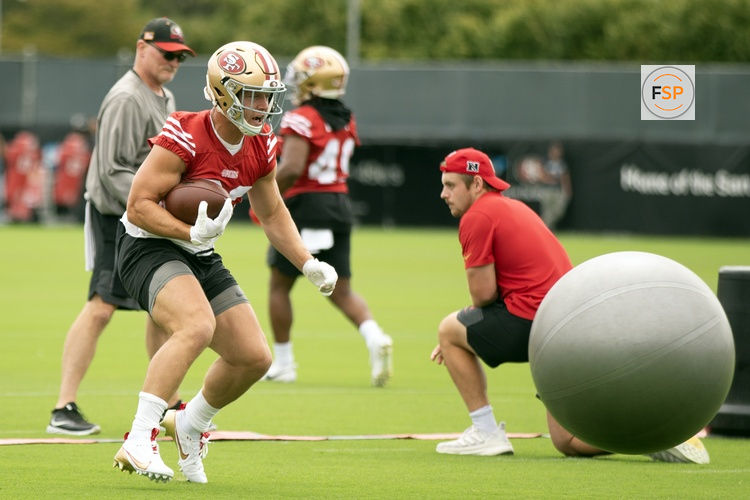
McCaffrey has a long list of injury woes in his career, most notably missing most of last season with a calf/Achilles injury. That injury wasn't reported as being serious until right before the season, catching fans and fantasy owners off guard. He played in just four games, making him THE fantasy bust of 2024 after being drafted first overall most often.
This year's initial injury is reportedly not serious, and McCaffrey is expected to play in Week 1. It's reasonable to be skeptical after 2024's debacle, but I tend to lean more into upside, and there aren't many guys who offer more fantasy potential than McCaffrey when he's on.
Newly acquired Brian Robinson (traded from the Commanders) would be the guy to step into the lead role if McCaffrey were to miss any time. He was lightly owned after the trade, but news of McCaffrey's possible ailment led to a spike in ownership, moving Robinson closer to 80%. As I'm still in on McCaffrey, I don't see much coming from Robinson, but the intrigue is there given the injury history of the star back.
I don't generally like the concept of running back handcuffs, but the guys who are worthy are those who would step right into a fantastic situation, like those players on the 49ers or Eagles. Because Robinson would theoretically jump into big-time production, he is worth grabbing as a handcuff to McCaffrey or even just an end-of-bench player if you don't own McCaffrey.